Buying a Second Home: Is It a Getaway or a Paycheck?
Owning a second home used to be a simple dream: a cabin in the woods or a condo by the beach where you could leave your flip-flops and forget about the world. But in the 2026 real estate market, that dream has gotten complicated. With shifting tax laws and higher interest rates, the "why" behind your purchase is now a high-stakes financial decision.
Are you buying a retreat for your family, or are you buying a business that happens to have a roof? The answer changes everything—from your monthly mortgage payment to the size of your tax refund.

1. The IRS "14-Day Rule": Your New Best Friend (or Worst Enemy)
The biggest mistake second-home buyers make is assuming they can "just rent it out sometimes" without consequences. The IRS is laser-focused on your intent. For the 2026 tax year, they categorize your home based on the "14-day or 10% rule."
The Tax-Free "Hobby" Rental
If you use the home as a residence and rent it out 14 days or fewer in the year, that rental income generally does not have to be reported. The personal-use tests matter, so confirm your situation with a CPA before relying on it. It’s essentially tax-free money to help cover your property taxes. On the flip side, you can’t deduct any rental-related expenses, but for most vacationers, this is the sweet spot.
The Mixed-Use Middle Ground
If you use the home personally for more than 14 days (or 10% of the days it’s rented), it’s a "residence." You report the income, but your deductions are limited. You can only deduct rental expenses up to the amount of income you made. You cannot use a "loss" on this house to lower the taxes on your day-job salary.
The Full-Scale Investment
If your personal use stays under the IRS threshold — the greater of 14 days or 10% of the days it is rented at fair market value — the property is generally treated as a rental, though passive-activity rules still govern how much of any loss you can use. This is where the big tax breaks live. You can deduct maintenance, travel to the property, utilities, and depreciation (writing off the house’s value over 27.5 years). If the house loses money on paper, that loss can often offset your other income.
2. The 2026 Tax Reality: SALT Caps and Mortgage Limits
The 2026 Tax Reality: SALT Caps and Mortgage Limits Thanks to the “One Big Beautiful Bill Act” updates, the 2026 tax landscape looks different than it did just a year ago.
- The SALT Cap: If you’re buying for personal use, remember to check the current SALT deduction cap and its income phase-out with your CPA before you count on a property-tax deduction — the figures are indexed and change year to year. If your primary home’s taxes already hit that ceiling, you get zero tax benefit for the property taxes on your second home.
- Mortgage Interest Limits: For mortgage debt taken on after December 15, 2017, interest is generally deductible on up to $750,000 of combined debt; older loans may fall under a higher limit. Have your CPA confirm which applies to you. That is the combined total for both your first and second homes. If you have a $500k mortgage on your main house, only the first $250k of your second home’s loan is tax-deductible.
- The Investment Loophole: These limits generally do not apply if the property is a pure rental investment. In that case, property taxes and interest are viewed as “business expenses,” which are typically fully deductible against the rental income.
If you'd like a second opinion on how this applies to your situation, there's more below.
3. Financing the Dream: Rates and Down Payments
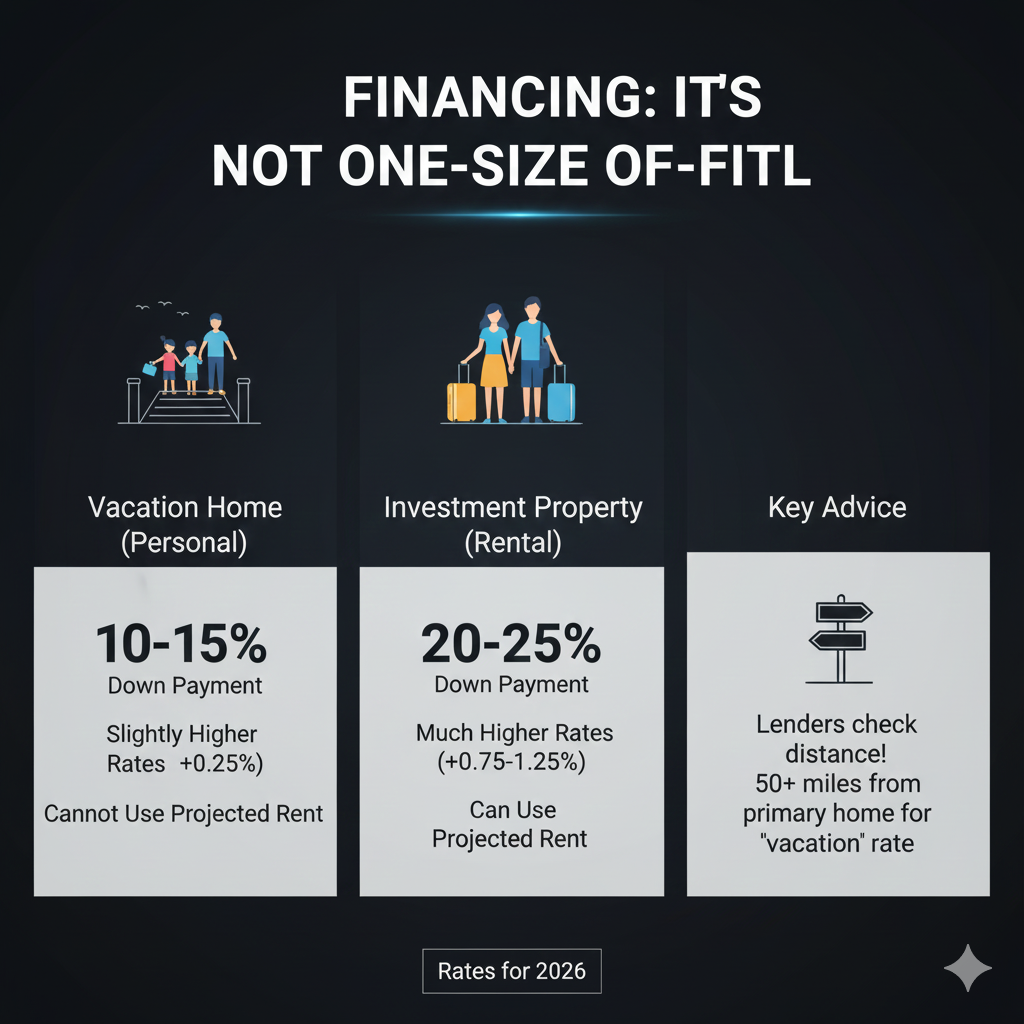
Lenders generally price and underwrite second homes and investment properties more conservatively than primary residences. The figures below are illustrative ranges, not program rules — your actual down payment, rate adjustment and credit requirements depend on the loan program, the lender's overlays and your file. They see second homes as "disposable" debt—if things go bad, you’ll stop paying for the beach house before you stop paying for your primary residence.
| Feature | Vacation Home (Personal) | Investment Property (Rental) |
| Minimum Down Payment | 10% – 15% | 20% – 25% |
| Interest Rates | Primary Rate + 0.25% | Primary Rate + 0.75% to 1.25% |
| Credit Score Goal | 680+ | 720+ |
| Income Qualification | Based purely on your salary | Often includes 75% of projected rent |
Key Advice: If you tell a lender it's a "vacation home" to get a lower rate but then list it on Airbnb full-time, that is technically occupancy fraud. Occupancy misrepresentation is a serious matter and lenders do check — don't risk it.
4. Maintenance: The "Invisible" Cost of Distance
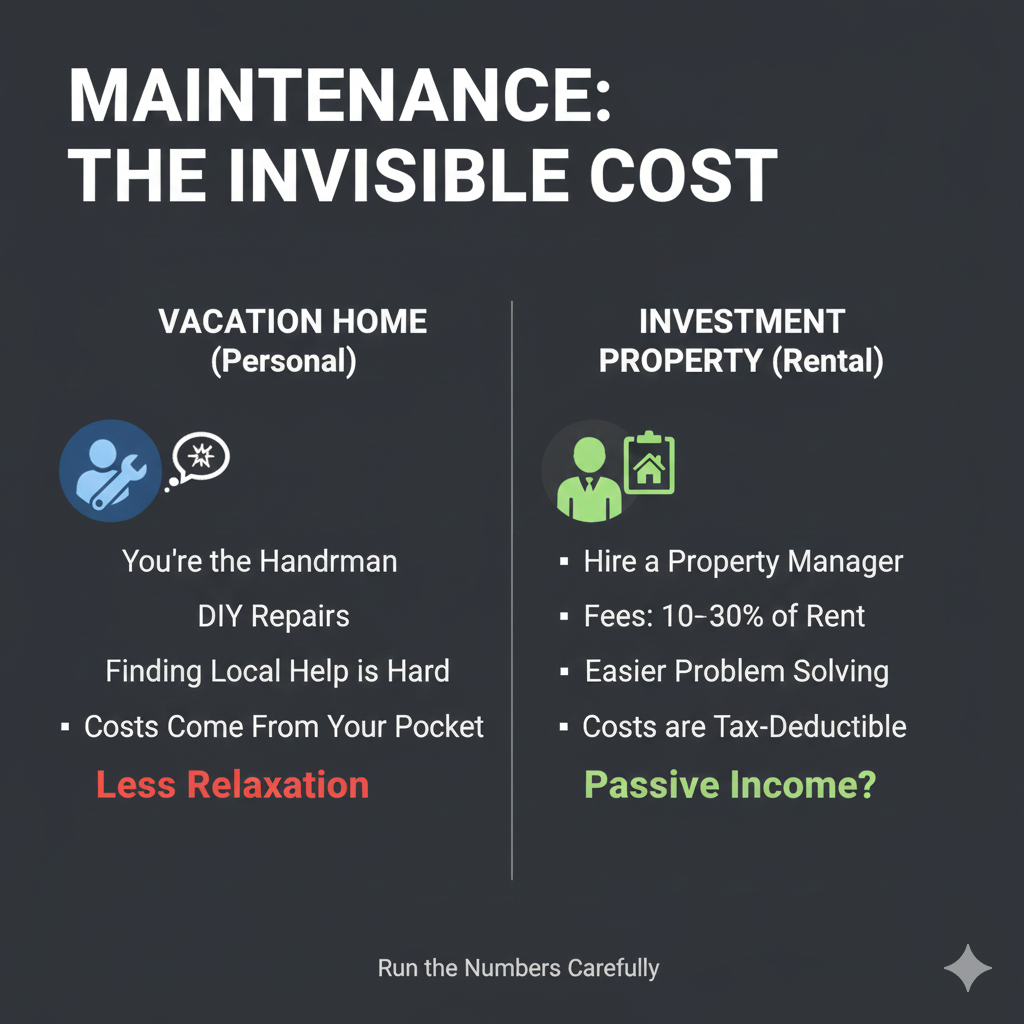
A second home is twice the work. If it's a vacation home, you’re the one mowing the lawn or fixing the leaky faucet when you’re supposed to be relaxing.
If it's a rental, you need a property manager. Property management fees vary by market and service level, and short-term rental management typically costs several times what long-term management does — get real quotes for your market before you model returns. When you’re running your ROI (Return on Investment) calculations, you must bake these costs in. A house that "breaks even" on the mortgage but costs $5,000 a year in repairs is a house that’s losing you money.
5. The Exit Strategy: Capital Gains Secrets
The Exit Strategy: Capital Gains Secrets How you classify the home today dictates how much you keep when you sell.
- The Primary Residence Pivot: You can move into a vacation home for two years to qualify for the Section 121 exclusion (up to $500k for married couples filing jointly). However, you won’t get the full tax break if the home was a second home first. The IRS uses a "pro-rata" rule: they look at how long you owned it versus how long it was your main home. If you owned a beach house for 10 years but only lived in it for the last 2, you can only exclude about 20% of the profit. The rest remains taxable.
- The 1031 Exchange: For rental investments, you have a more powerful tool: the 1031 Exchange. Done correctly, this lets you defer capital gains by rolling proceeds into another investment property — the identification and closing deadlines are strict, the tax is deferred rather than erased, and you need a qualified intermediary and a CPA involved from the start
Final Verdict: Which Path is Yours?
- Choose a Vacation Home if: You value memories over monthly cash flow. You want a place that is yours, decorated your way, and available whenever you want it.
- Choose a Rental Investment if: You want a wealth-building tool. You’re okay with strangers sleeping in your beds if it means they’re paying off your mortgage and building your equity.
Next Steps for You
Before you go to an open house, do these three things:
- Talk to your CPA: See how the current SALT cap and the mortgage interest limit apply to your situation.
- Get a "Service Area" Pre-Approval: Some lenders have better rates for specific vacation zones.
- Run the 14-Day Math: Decide now if you're going to be a "Hobbyist" or a "Professional."